Quick Facts
- Calorie Burn: Vigorous movement burns approximately 7 to 15 calories per minute depending on intensity.
- Primary Muscles: Focuses on hip flexors, quadriceps, hamstrings, and the deep core.
- Aging Support: Helps counteract muscle loss and reduces chronic knee pain risk by up to 23%.
- Equipment Options: Best performed with light dumbbells (1-5 lbs) or ankle weights.
- Key Outcome: Significant improvements in gait stability, bone density, and functional independence.
- Difficulty Level: Accessible for beginners with modifications; easily scalable for advanced athletes.
Weighted high knees combine cardiovascular conditioning with resistance training to enhance lower body and core strength. By adding weights, you apply progressive overload to the hip flexors, quads, and hamstrings, which helps increase bone density and metabolic rate. This exercise also improves functional mobility and gait stability, making daily tasks easier for active seniors.
The Power of Resistance: Benefits of Weighted High Knees for Seniors
As we age, the way we move dictates how we live. Many people view high knees as a track-and-field drill reserved for young athletes, but when we introduce resistance, this movement transforms into a vital tool for active aging. The physiological benefits are backed by clear data. We know that incorporating weights into functional movements like high knees can help counteract the natural decline in muscle mass that typically begins to occur each year after the age of 30. By challenging your muscles now, you are essentially investing in your future mobility.
One of the most compelling reasons to start incorporating weighted high knees into senior strength routines is the protection they offer your joints. It might seem counterintuitive to add weight when you have "bad knees," but the research suggests otherwise. Individuals who participate in regular weightlifting have a 17% to 23% lower risk of experiencing chronic knee pain or developing osteoarthritis compared to those who do not. The resistance strengthens the muscles surrounding the knee, providing a natural brace that absorbs impact and reduces wear and tear on the cartilage.
Beyond joint health, the benefits of weighted high knees for seniors extend to the very way we walk. This exercise relies heavily on unilateral training, which means working one side of the body at a time. This specifically targets gait stability. When you lift one weighted leg, your standing leg and core must work overtime to keep you upright. This mimics the mechanics of stepping over an obstacle or recovering from a trip, which is essential for fall prevention. By consistently practicing these movements, you improve your ability to navigate uneven sidewalks or climb stairs with confidence.
Master the Move: Standing High Knees with Dumbbells Form
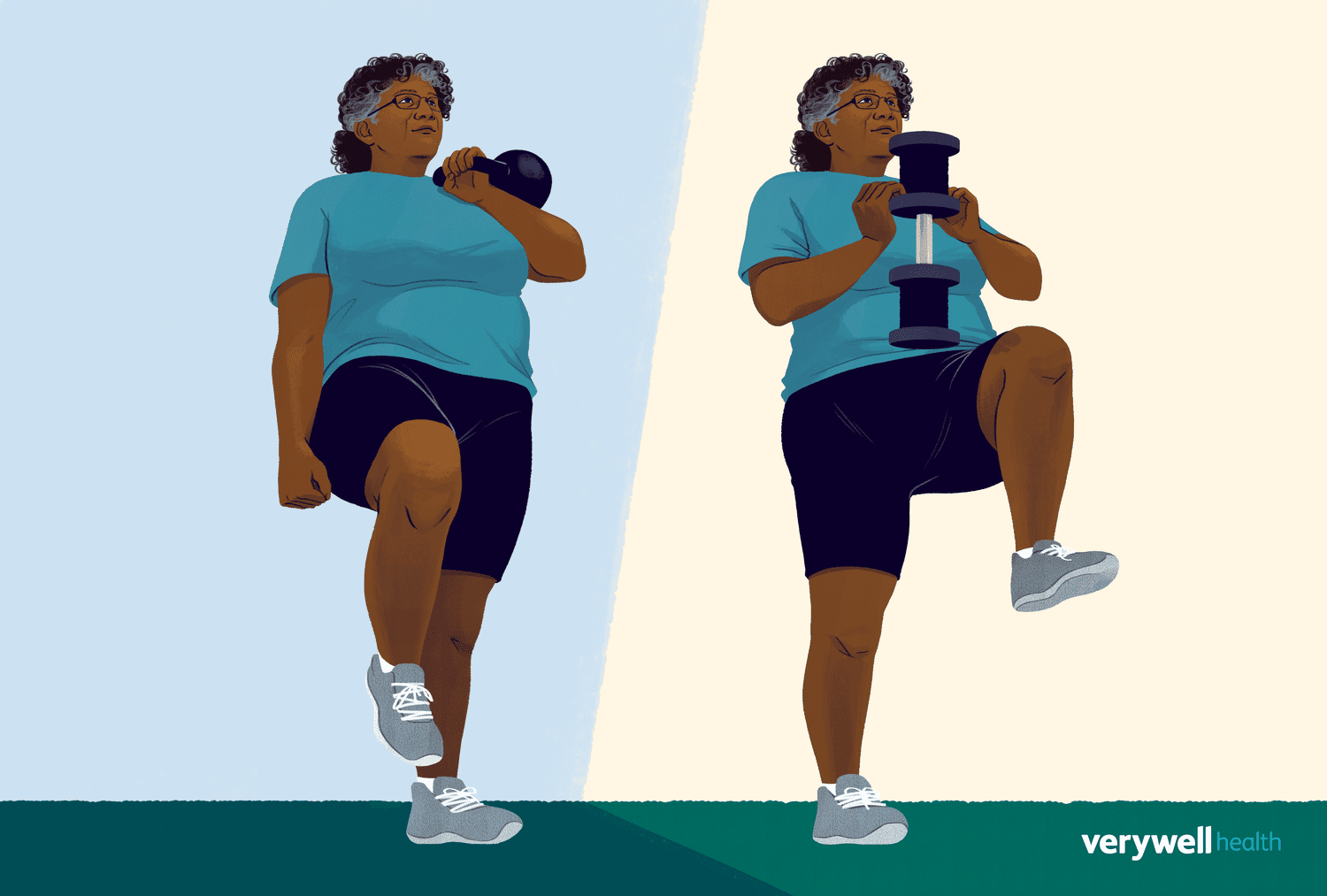
To reap the rewards of this exercise, precision is far more important than speed. When learning the standing high knees with dumbbells form, think of yourself as a pillar of strength. Your goal is to remain perfectly upright, resisting the urge to lean back as the weight of your leg increases.
- Begin by standing with your feet shoulder-width apart. Hold a light dumbbell in each hand at your sides.
- Engage your core by pulling your belly button toward your spine. This creates a stable base.
- As you exhale, lift your right knee toward waist level. Focus on a controlled range of motion rather than trying to kick as high as possible.
- While your leg is elevated, your upper body stays active. Your shoulders should be down and back, engaging your traps and lats to keep the dumbbells steady at your sides.
- Lower the leg slowly and land softly on the ball of your foot. This soft landing protects your joints and engages your calves.
- Switch legs and repeat the process in a rhythmic, marching motion.
The difference between weighted high knees vs bodyweight high knees for strength lies in the intensity of the muscle contraction. Without weights, the movement is largely aerobic. Once you add dumbbells, your hip flexors and quads must generate significantly more force to overcome gravity. This extra effort is what triggers the body to build more muscle fiber and increase bone density.
Finding Your Dosage: Ankle Weight Exercises for Balance
While dumbbells are excellent for overall load, ankle weight exercises for balance offer a unique advantage. Because the weight is placed further from your center of gravity, it creates a longer lever arm, which makes your stabilizer muscles work much harder. This is where you really start to hone your proprioception—your body's ability to sense its position in space.
When considering how to add weights to high knees safely, the general rule of thumb is to start with a dosage that feels manageable but challenging. Most fitness professionals recommend the 1% rule: start with weights that equal roughly 1% of your total body weight. For most people, this means starting with 1-lb or 2-lb ankle weights. Exceeding 3-5% of your body weight too quickly can lead to strained hip flexors or a breakdown in form, such as a rounded lower back.
Ankle weight exercises for balance and stability are particularly effective because they force the small muscles around the ankle and foot to fire rapidly to maintain alignment. As you progress, you can move from a slow, deliberate march to a more rhythmic pace. The key is to ensure that the weight never dictates your movement; you should always be in full control of the descent of your foot.
Safety First: Modifications and Core Engagement
We always prioritize longevity over ego. If you find that holding weights makes you feel unsteady, don't hesitate to use low-impact modifications. You can perform the exercise while standing next to a sturdy chair or a wall, using one hand for balance while the other holds a weight. This allows you to still get the benefits of weighted high knees for core and leg strength without the fear of falling.
Core engagement is the "secret sauce" of this exercise. Your hip flexors are attached to your spine and pelvis; if your core is weak, your lower back will arch every time you lift your leg. To prevent this, focus on your breathing. Exhale forcefully as you lift your knee. This "forced exhalation" naturally engages the deep transverse abdominis, which acts like a corset to protect your spine.
If you are a beginner, start with just one set of 10 repetitions per leg. As your stamina improves, you can increase the duration. Remember that vigorous high knees can burn approximately 7 calories per minute, and as you increase the intensity with weights, that number can climb to 15 calories per minute. It is an incredibly efficient way to boost your metabolic rate while building functional power.
FAQ
What are the benefits of weighted high knees?
Weighted high knees provide a dual benefit of cardiovascular conditioning and resistance training. They specifically target the hip flexors, quads, and core, helping to increase bone density and metabolic rate. For older adults, they are a premier exercise for improving gait stability and maintaining the functional mobility needed for daily independence.
How do you perform high knees with weights correctly?
To perform the move correctly, stand with feet shoulder-width apart and hold weights at your sides or on your ankles. Lift one knee toward your waist while keeping your torso upright and your core tight. It is vital to land softly on the ball of your foot and avoid leaning backward, which ensures the work stays in your legs and abdominals rather than your lower back.
Are weighted high knees safe for beginners?
Yes, they are safe for beginners provided you start with very light weights and focus on form over speed. Beginners should use low-impact modifications, such as performing a controlled march rather than a running motion. Using a chair for balance is also highly recommended during the initial weeks to prevent joint strain and ensure safety.
Should I use ankle weights or a weighted vest for high knees?
Both have benefits, but they serve different purposes. Ankle weights are superior for targeting the hip flexors and improving proprioception and balance due to the weight being at the end of the limb. A weighted vest distributes the load across the torso, which is excellent for overall cardiovascular demand and bone density but may not challenge your balance as specifically as ankle weights.
Can you do high knees while holding dumbbells?
Yes, standing high knees with dumbbells is a common and effective variation. Holding dumbbells at your sides or at shoulder height adds a challenge to your core and upper body stabilizers. This version is often easier for beginners to control than ankle weights because the weight is closer to the body’s center of gravity.